顯示具有 Science Pictures 標籤的文章。 顯示所有文章

4.29.2010

分享極光喔

在太空看的
在地球看的喔
分享極光
這是地磁保護我們FROM太陽的輻射形成的喔
要好好感謝地磁喔~

一個是從地球看啦 一個是從太空看囉
--
~ ●   ●
/▲V▲\            
  /\    /\          
                 
My MSN Space
http://secretssher770410.spaces.live.com/

Sher's Pictures~
http://cid-937b06479e557080.skydrive.live.com/albums.aspx

MY FACEBOOK(中國大陸的朋友請用"自由門"開啟喔)
http://www.facebook.com/PhilangeSherDelacour

老舊的無名(中國大陸的朋友請用"自由門"開啟喔)
http://www.wretch.cc/blog/sher770410

我滴人人網=開心網(原校內網)
http://renren.com/profile.do?id=272045169&_vip_flag=85

我的plurk(中國大陸的朋友請用"自由門"開啟喔)
http://www.plurk.com/philangeSherdelacour/invite

6.04.2009

when something die and something born


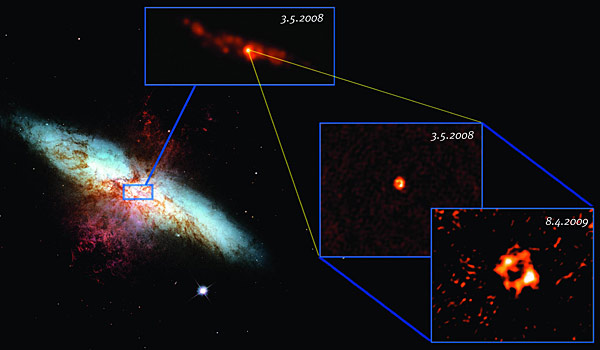
Rare radio supernova is nearest supernova in five years

A Hubble Space Telescope image (left) of the galaxy M82 shows hydrogen gas (red) breaking out from the central starburst (box), a region of intense star formation. A May 2008 VLA image of the starburst region (top left) clearly shows the supernova (SN 2008iz), which probably exploded in January 2008. The two high-resolution VLBA images (lower right) show an expanding shell at the scale of a few light days and proves that the transient source was the result of a supernova. (Milde Science Communication; HST image: NASA, ESA and the Hubble Heritage Team [STScI/AURA]; Radio images: A. Brunthaler, MPIfR)

1.05.2009

格陵蘭上空的壯美“風暴雲”


這種壯觀景象很難見到。
據英國《每日郵報》報道,英國北極攝影師布賴恩和謝利·亞歷山大近日在格陵蘭西北拍下天空中驚人美麗的風暴雲。這些照片看起來像是世界終結的景象而不是冬天裡的日出場面。
當烏雲開始密布英格爾菲爾德(Inglefield)灣上空時,這對獲獎的攝影師正好在距離北極大約1280公裡的誇那(Qaanaaq)鎮因紐特人居住區。謝利先生表示黎明前他正在屋外看天,正好看到這種美麗且變幻多樣的雲彩。他說:“我簡直難以相信我的眼睛。過去37年裡我常常來北極工作,但從來沒有看到這樣的天空。”
這些照片表明中間薄薄的一層雲被風吹打著,在下面冰河之間攪和在一起。據稱這是地形效應造成的,也就是說,風從一則吹來之後,經過山峰時被抬升起來了,于是在下山前就會吹打雲彩。而日出角度正好突現這些雲彩的不同顏色和復雜的雲彩形狀。攝影師表示這些畫面像盤古開天時的場景。(來源:網易探索)

12.23.2008

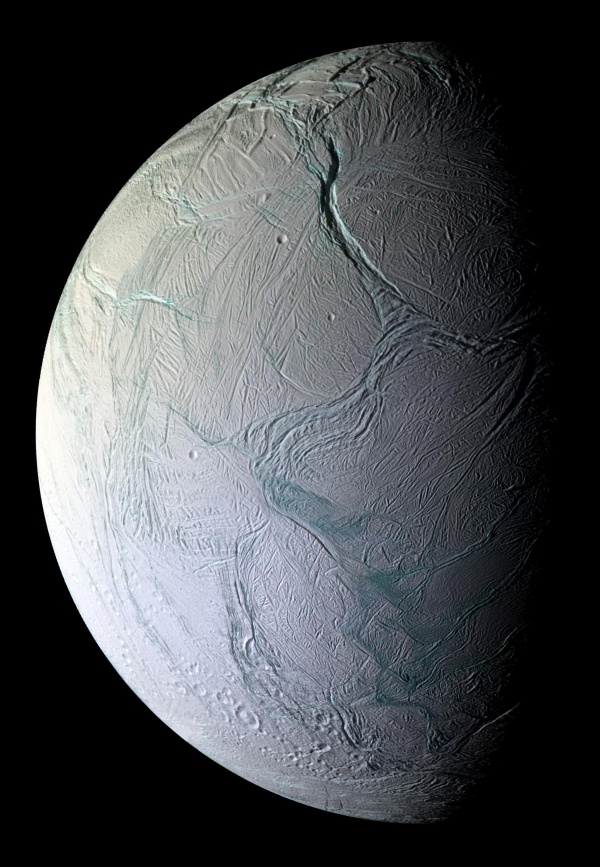
We might have some friends on Enceladus


Labtayt Sulci on Saturn's Enceladus Credit: Cassini Imaging Team, SSI, JPL, ESA, NASA
Explanation: Do some surface features on Enceladus roll like a conveyor belt? A leading interpretation of recent images taken of Saturn's most explosive moon indicate that they do. This form of asymmetric tectonic activity, very unusual on Earth, likely holds clues to the internal structure of Enceladus, which may contain subsurface seas where life might be able to develop. Pictured above is a composite of 28 images taken by the robotic Cassini spacecraft in October just after swooping by the ice-spewing orb. Inspection of these images show clear tectonic displacements where large portions of the surface all appear to move all in one direction. Near the top of the image appears one of the most prominent tectonic divides: Labtayt Sulci, a canyon about one kilometer deep.

12.22.2008

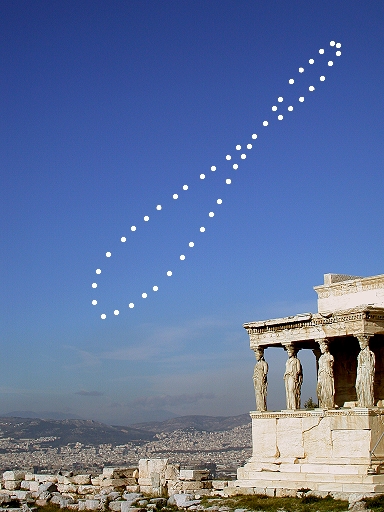
Analemma Over the Porch of Maidens


Analemma Over the Porch of Maidens Credit & Copyright: Anthony Ayiomamitis (TWAN)
Explanation: If you took a picture of the Sun at the same time each day, would it remain in the same position? The answer is no, and the shape traced out by the Sun over the course of a year is called an analemma. The Sun's apparent shift is caused by the Earth's motion around the Sun when combined with the tilt of the Earth's rotation axis. The Sun will appear at its highest point of the analemma during summer and at its lowest during winter. Today, the Winter Solstice day in Earth's northern hemisphere, the Sun is at the bottom of the analemma. Analemmas created from different latitudes would appear at least slightly different, as well as analemmas created at a different time each day. This particular analemma was built up by 46 separate Sun photographs taken during 2003 in Athens, Greece. Pictured in the foreground of this composite image are pillars called the Porch of Maidens, part of the ancient Erechtheum which was completed in 407 BC.

12.18.2008

當Eddi愛上赤豆元宵~

今天媽咪給你帶來"赤豆元宵"
其實就是紅豆湯圓啦 哈哈哈


Eddi"mommy 今天給我帶來什麼好料阿??"


Sher"赤豆元宵喔 希望你喜歡阿 寶貝!!"


(呵呵 他還沒發現就在旁邊喔)


Eddi"呵呵 我來試試味道~"(哼著歌~)
Sher"不是咬盒子吧 = ="


Eddi"呵呵 我愛 我愛 謝謝啦~"


Eddi"呵呵 甜甜的 好好吃喔 "

12.10.2008

Portrait of NGC 281


Portrait of NGC 281 Credit & Copyright: Ken Crawford (Rancho Del Sol Observatory)
Explanation: Look through the cosmic cloud cataloged as NGC 281 and it's almost easy to miss stars of the open cluster IC 1590. But, formed within the nebula, that cluster's young, massive stars ultimately power the pervasive nebular glow. The eye-catching shapes looming in this colorful portrait of NGC 281 are sculpted columns and dense dust globules seen in silhouette, eroded by intense, energetic winds and radiation from the hot cluster stars. If they survive long enough, the dusty structures could also be sites of future star formation. Sometimes called the Pacman Nebula because of its overall shape in wider-field views, NGC 281 is about 10,000 light-years away in the constellation Cassiopeia. This composite image was made through narrow-band filters and shows emission from the nebula's hydrogen, sulfur, and oxygen atoms in green, red, and blue hues. It spans over 80 light-years at the estimated distance of NGC 281.